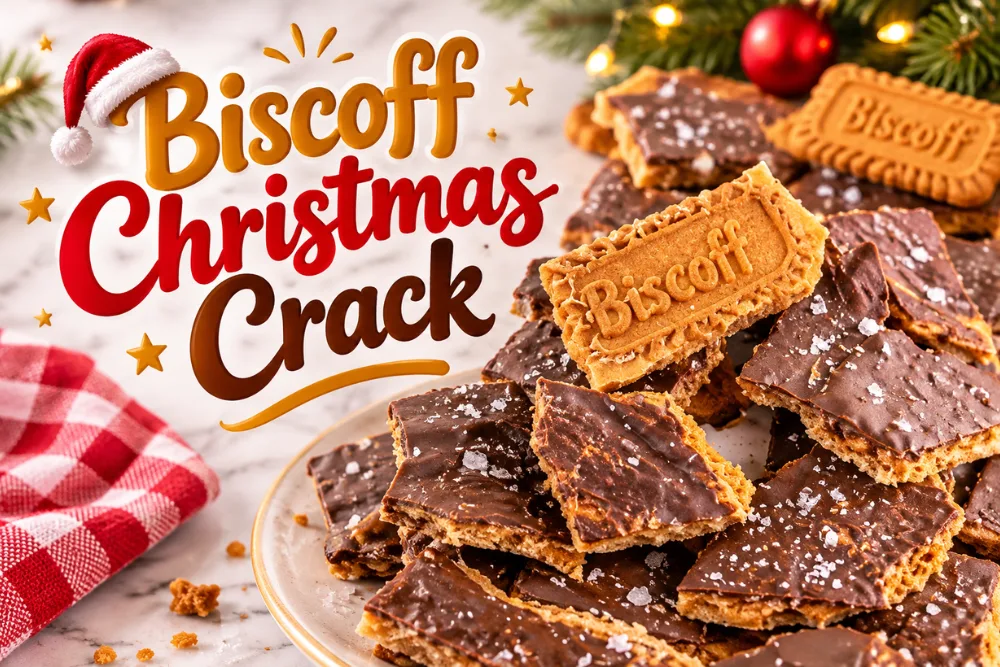
Biscoff Christmas crack is a holiday bark made by laying Lotus Biscoff cookies on a tray, pouring hot buttery brown sugar toffee over them, baking until bubbly, then covering the lot with melted chocolate and a swirl of Biscoff cookie butter.
Once it hardens, you break it into rough pieces. It needs one sleeve of cookies, a saucepan and a spell in the fridge, and it follows the same idea as the original Christmas crack, with Biscoff cookies standing in for salted crackers.
Have you ever wondered how a tray of crackers, butter and sugar turned into one of the most talked about holiday treats online? The story is worth knowing, because it explains why the Biscoff version works so well.
Where Christmas crack comes from
This deceptively simple dessert was made famous in America, where the base is a salted cracker called a saltine. In Australia the same cracker goes by the name Salada, and Australian bakers took to the treat with real enthusiasm once versions of it began appearing on food sites there.
The appeal sits in the contrast. A salty, crisp base meets soft toffee, and a layer of rich chocolate finishes it. Nothing about it is complicated, which is a large part of why it spread.
A 2022 write up described it as the trending holiday snack that had taken the internet by storm. It credited food creator Mary Sommer with making #ChristmasCracks go viral, and reported that her version collected more than 60 million views in a short span.
You can see the video that started it on Mary Sommer’s TikTok. The recipe it popularised is easy to make: salted crackers on the bottom, caramel on top, then melted chocolate chips.
You may also try: Italian Christmas Cookies Recipe
How the Biscoff version changes the idea
Biscoff Christmas crack keeps the structure and changes the base. It is a sweet holiday bark that swaps the traditional saltines for Lotus Biscoff cookies.
Two additions make it feel like its own recipe rather than a substitution. Melted Biscoff cookie butter is swirled through the chocolate, and crushed Biscoff cookies go on top, so the flavour of the base carries through every layer.
Salt still matters, though it arrives differently. With the salted crackers gone, the recipe uses a pinch of salt in the toffee and flaky sea salt scattered over the finished bark.
What you need
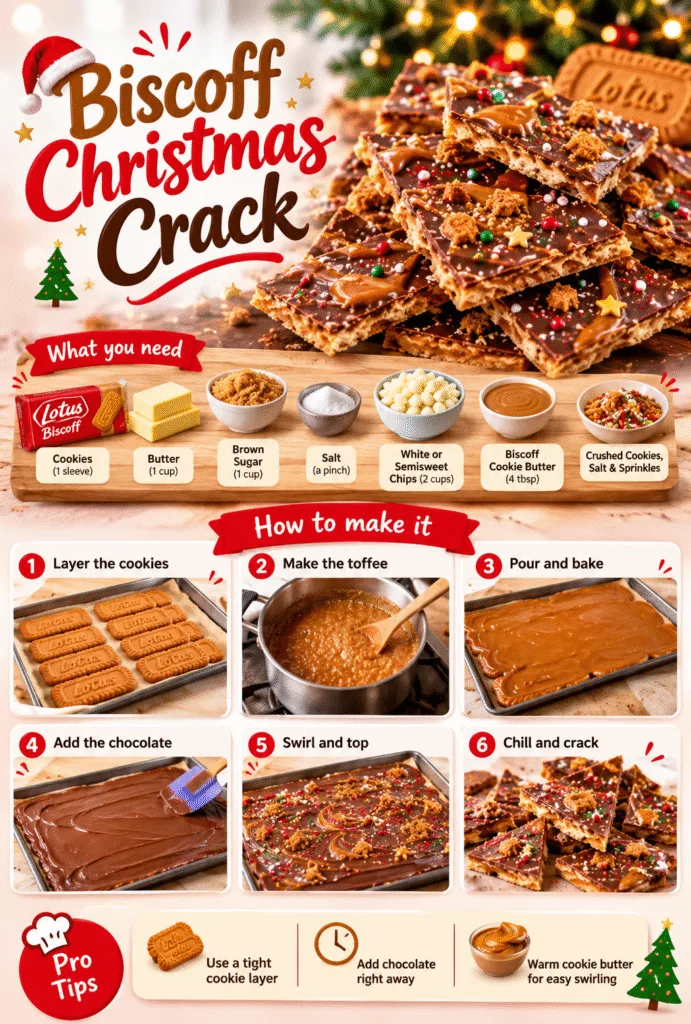
- 1 sleeve of Lotus Biscoff cookies, about 8 oz (roughly 150g to 220g)
- 1 cup (226g, or 2 sticks) unsalted butter
- 1 cup (220g) packed brown sugar
- A pinch of salt
- 2 cups (320g) white chocolate chips or semisweet chocolate chips
- 4 tablespoons (58g) Biscoff cookie butter, melted
- For the top: crushed Biscoff cookies, flaky sea salt and festive Christmas sprinkles
Choosing white or semisweet chocolate
The recipe works with either. White chocolate gives a pale layer that makes sprinkles stand out, while semisweet gives a darker finish. Pick the one you would most like to see on your holiday table.
How to make it
- Layer the cookies. Heat your oven to between 375°F and 400°F (about 190°C to 205°C). Line a baking sheet with parchment paper and arrange the Biscoff cookies in a single, tight layer across the pan.
- Make the toffee. In a saucepan, melt the butter and brown sugar together with a pinch of salt. Bring it to a boil and cook it, stirring, for about 3 to 4 minutes, until it turns into a rich caramel toffee.
- Pour and bake. Pour the hot toffee evenly over the cookies. Bake for about 5 to 8 minutes, until the toffee is bubbly and set.
- Add the chocolate. Take the pan out of the oven and scatter the chocolate chips over the hot toffee straight away. Leave them for 2 minutes to melt, then spread the chocolate into a smooth layer with a spatula.
- Swirl and top. Drizzle the warmed Biscoff cookie butter over the chocolate and swirl it gently with a knife or toothpick. Scatter on the crushed Biscoff cookies, flaky sea salt and Christmas sprinkles.
- Chill and crack. Let it cool completely at room temperature, or put it in the fridge or freezer for 1 to 2 hours until fully hardened. Break it into irregular pieces to serve.
Small details that shape the result
The first thing to get right is the cookie layer. Every piece of bark sits on a Biscoff cookie, so a tight, single layer keeps the base even and avoids bare patches once the toffee sets.
Timing matters just as much at the chocolate stage. The heat from the freshly baked toffee is what melts the chips, which is why they go on the moment the pan leaves the oven. The 2 minute rest is your signal to start spreading.
The cookie butter is worth warming before you drizzle it. A warmed, melted spoonful moves easily across the chocolate, so you can swirl it with a knife or toothpick instead of dragging it around.
Biscoff Christmas crack or the classic saltine version?
The classic version uses a salted cracker, which gives a salty, crisp base under the toffee and chocolate. The Biscoff version uses cookies instead and adds a cookie butter swirl and crushed cookie topping, so it leans sweeter and more cookie focused from top to bottom.
If you could only make one tray this season, which would you choose: the salty bite of the original, or the Biscoff twist?
Frequently asked questions
Can I use saltine crackers instead of Biscoff cookies?
Yes. Saltines are what the original Christmas crack is made with, and in Australia they are known as Salada crackers. The Biscoff version is a swap for those salted crackers, so going back to them simply returns you to the classic recipe.
Should I use white chocolate or semisweet chocolate chips?
Both are included in the recipe. Use 2 cups (320g) of whichever you prefer, and spread them over the hot toffee after the 2 minute rest.
How do I know when the toffee is ready?
Look for a rich caramel colour after boiling and stirring for about 3 to 4 minutes. After it goes in the oven, it should be bubbly and set by the 5 to 8 minute mark.
How long does it take for the bark to harden?
Allow 1 to 2 hours in the fridge or freezer, or let it cool completely at room temperature. It is ready to break up once it has hardened fully.
What goes on top of Biscoff Christmas crack?
Crushed Biscoff cookies, flaky sea salt and festive Christmas sprinkles, added after you swirl the melted cookie butter through the chocolate.
Who made Christmas crack go viral?
A 2022 write up credited food creator Mary Sommer with making #ChristmasCracks a viral trend, with more than 60 million views for her saltine cracker toffee recipe.
Why this tray of toffee keeps coming back
A few pantry ingredients, one saucepan and a short bake are all it takes, and the result looks far more impressive than the effort involved. The Biscoff twist gives a familiar favourite a new base, and the sprinkles do the rest.
Also try: