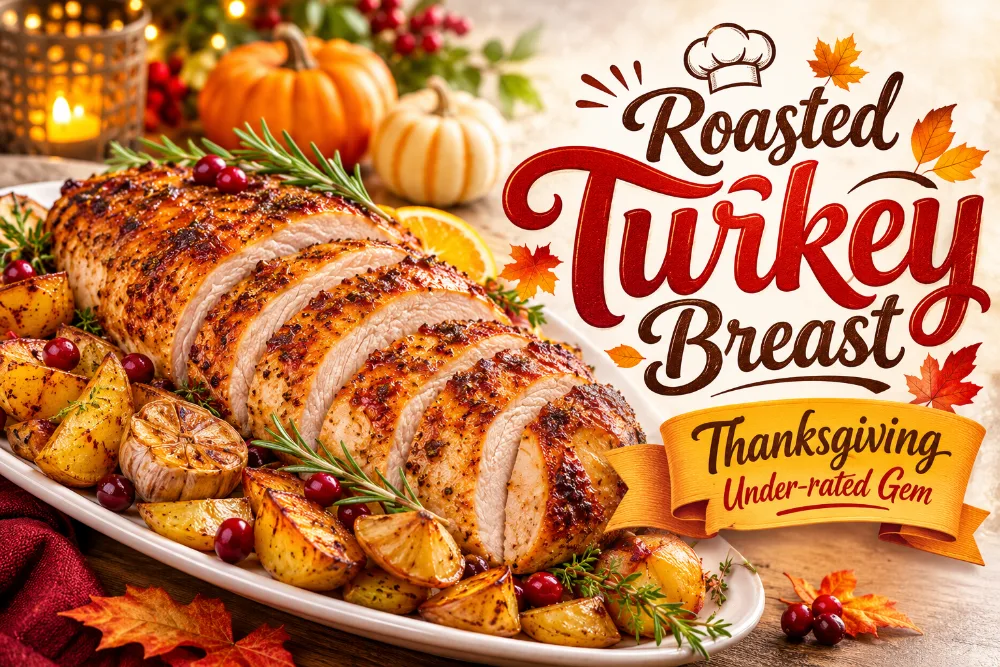
Roasted turkey breast is the easiest way to get a proper Thanksgiving centerpiece on the table without wrestling a whole bird. A 4 to 5 pound breast roasts in under two hours at 350°F, feeds 6 to 8 people, and stays juicy if you pull it from the oven at the right moment. Thanksgiving falls on Thursday, November 26, 2026, so there is still plenty of time to practice.
Why a Turkey Breast Might Be the Smarter Choice This Year
A whole turkey asks a lot of the cook. The lean breast cooks faster than the dark meat in the thighs and drumsticks, so by the time the legs are done, the breast has often gone dry. Cooking only the breast removes that problem. You decide when it is done, and nothing else is competing for oven time.
There is also the practical side. A breast gives you large, even slices, a fraction of the cleanup, and the familiar smell of a holiday dinner. That suits small families, couples hosting for the first time, and anyone who wants a relaxed Thursday.
Have you ever served a turkey where half the table got perfect meat and the other half got chalk? This is the fix.
A Short History of the Turkey Breast
Turkeys are native to North America. They were domesticated by the Aztecs in Mexico and by Indigenous peoples in the American Southwest thousands of years before European colonization. By the mid nineteenth century, the whole roasted turkey had become the centerpiece of American Thanksgiving.
The standalone breast arrived later. It became hugely popular in the late twentieth century, as smaller households and health conscious shoppers wanted a convenient, lean source of protein.
Why Turkey Breast Dries Out, and How to Stop It
The breast is entirely white meat, with very little fat and connective tissue compared to thighs and drumsticks. Those are the things that keep meat forgiving. Without them, a few extra minutes in the oven can turn tender slices into something chalky.
Most dry turkey comes from overcooking out of fear, not from the cut itself. Three habits fix it.
Use a Thermometer and Trust Carryover Cooking
Heat does not stop moving when the turkey leaves the oven. The warmth stored in the outer layers keeps traveling inward while the meat rests, raising the core temperature. Take the breast out at 160°F (71°C) and it will climb to the FDA recommended safe temperature of 165°F (74°C) as it rests. Check the thickest part with an instant read thermometer, and confirm 165°F (74°C) before you carve.
Put Fat Under the Skin
Butter slipped beneath the skin bastes the meat from the inside as it roasts. It adds flavor and gives the lean breast the richness it naturally lacks.
Dry the Skin Before Roasting
Pat the skin completely dry with paper towels. Surface moisture creates steam, and steam makes rubbery skin. A dry surface lets the butter render and the Maillard reaction brown the skin properly, which is where that crisp, golden finish comes from.
The Garlic Herb Roasted Turkey Breast
| Detail | Amount |
|---|---|
| Prep time | 15 minutes |
| Cook time | About 1 hour 15 minutes to 1 hour 45 minutes, or roughly 15 to 20 minutes per pound |
| Servings | 6 to 8 |
| Target internal temperature | 165°F (74°C) after resting |
Ingredients
For the turkey:
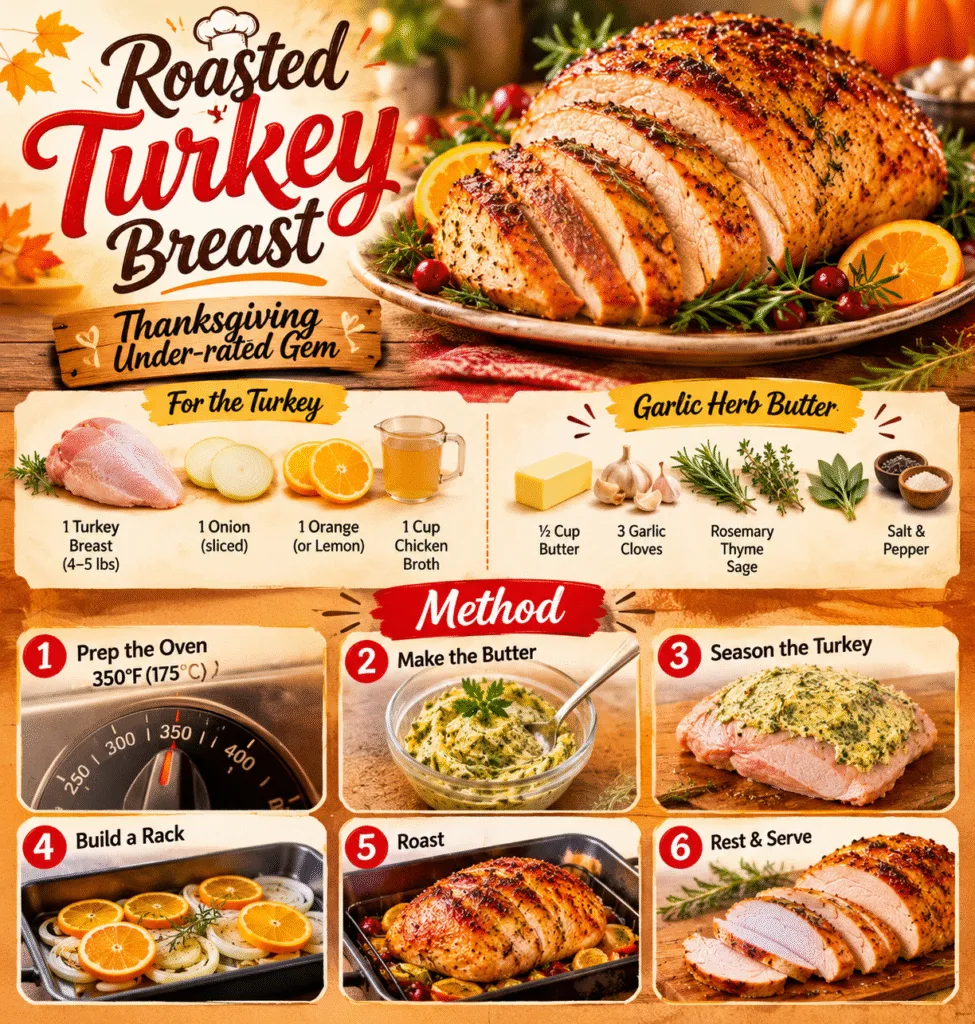
- 1 whole turkey breast, 4 to 5 pounds, bone in or boneless, skin on and fully thawed
- 1 onion, sliced
- 1 orange or lemon, sliced
- 1 cup low sodium chicken broth
For the garlic herb compound butter:
- 1 stick (½ cup) unsalted butter, softened
- 3 garlic cloves, minced
- 2 teaspoons fresh rosemary, chopped
- 2 teaspoons fresh thyme, chopped
- 1 tablespoon fresh sage, chopped
- 2 teaspoons kosher salt
- 1 teaspoon black pepper
Method
- Prep the oven and turkey. Preheat the oven to 350°F (175°C). Pat the turkey breast completely dry.
- Make the compound butter. In a small bowl, mash the butter with the garlic, rosemary, thyme, sage, salt, and pepper until fully combined.
- Season under the skin. Gently slide your fingers beneath the skin to separate it from the meat and create a pocket. Rub about half the herb butter directly onto the meat, then smear the rest evenly over the outside of the skin.
- Build a natural rack. Lay the onion and citrus slices in the bottom of a roasting pan or large cast iron skillet. Set the turkey on top, skin side up, and pour the chicken broth into the pan.
- Roast. Bake uncovered. If the skin browns too quickly, tent it loosely with aluminum foil. Start checking the temperature with an instant read thermometer in the thickest part once you reach the lower end of the time range. Pull the turkey at 160°F (71°C) if you want to rely on carryover cooking, and make sure it reads 165°F (74°C) after resting.
- Rest before carving. Move the turkey to a cutting board and let it rest for 15 minutes. This keeps the juices in the meat instead of on the board.
Turn the Pan Drippings Into Gravy
Do not throw away what is left in the pan. Skim off about 2 cups of the drippings and pour them into a small saucepan over medium heat. Whisk in 3 to 4 tablespoons of all purpose flour until smooth, then simmer for 3 minutes until thickened. Finish with a splash of heavy cream or half and half for a rich holiday gravy.
Why the Leftovers Are Half the Reason to Cook It
Turkey breast is dense in lean protein. A 3 ounce (85g) serving of skinless roasted breast has roughly 25 grams of protein and only about 1 to 2 grams of fat. It behaves much like chicken breast but gives you larger, more uniform slices, which suits sandwiches, salads, and wraps for days afterward.
Its mild flavor is also an advantage. Turkey takes on brines, marinades, and heavy herb rubs well, so garlic herb butter is only one direction. Chipotle paste or Mediterranean spices would work in the same way.
The Tryptophan Myth
Turkey contains L-tryptophan, an essential amino acid the body uses to make serotonin and melatonin. But studies show turkey does not contain meaningfully more of it than chicken, beef, or cheese. That sleepy feeling after dinner mostly comes from the heavy portions of stuffing, potatoes, and pie on the plate beside it. Does that sound familiar?
Thanksgiving 2026 Dates and Costs to Plan Around
Thanksgiving Day is Thursday, November 26, 2026, the fourth Thursday of the month. Thanksgiving week runs from Monday, November 23 to Sunday, November 29. Black Friday is November 27, and Cyber Monday follows on November 30. Canadian Thanksgiving has already passed, on Monday, October 12. You can confirm dates at Time and Date.
What the Costco Meal Bundle Says About Cost
If cooking from scratch is not your plan, Costco offers a complete Thanksgiving bundle at $199.99, marked down from $269.99 with a $70 manufacturer’s discount available through November 30 while supplies last. It includes a 5 pound turkey breast, mashed potatoes, gravy, mac and cheese, sweet corn, green bean casserole, candied yams, cornbread stuffing, cranberry relish, 12 dinner rolls, apple cobbler, and a whole pumpkin pie.
It ships frozen through FedEx with second day delivery. Preorders close November 13, with deliveries between November 4 and November 20.
The reason the price stands out is that food costs are rising. The September Bureau of Labor Statistics consumer price index shows food at home up 1.8% from a year ago, while food away from home is up 3.5%. Overall food prices are up about 2.5%. You can explore the data at the Bureau of Labor Statistics.
Frequently Asked Questions About Roasted Turkey Breast
How long does a 4 to 5 pound turkey breast take to roast?
At 350°F, plan on roughly 15 to 20 minutes per pound, which works out to about 1 hour 15 minutes to 1 hour 45 minutes. Treat that as a guide and rely on your thermometer.
Should I pull the turkey at 160°F or 165°F?
Both can work. Removing it at 160°F (71°C) lets carryover cooking bring the core to the safe target of 165°F (74°C) during the 15 minute rest. Confirm the final temperature before you carve.
Why does my turkey breast turn out dry even when I follow a recipe?
Usually it is overcooking. Breast meat has little fat or collagen to protect it, so going past the target temperature dries it quickly. Keeping the skin on, adding butter under it, and using a digital thermometer all help.
Is bone in or boneless better for this recipe?
The supplied recipe works with either, so choose what is easier for you to find and carve.
Do I really need to dry the skin first?
Yes. Moisture on the surface turns to steam and softens the skin. A dry surface lets the fat crisp it properly.
Is turkey breast a healthy choice?
It is one of the leanest animal protein sources, with about 25 grams of protein and only 1 to 2 grams of fat in a 3 ounce skinless serving.
Does turkey really make you sleepy?
Not by itself. Turkey has about the same tryptophan as chicken, beef, or cheese. The carbohydrates on the plate are the more likely cause.
A Simpler Holiday Table Starts Here
A good Thanksgiving does not need a 20 pound bird or a full day of stress. A garlic herb turkey breast, a thermometer, and a pan of gravy get you most of the way. Practice once before the 26th, and see how much easier the day feels.
Also try: