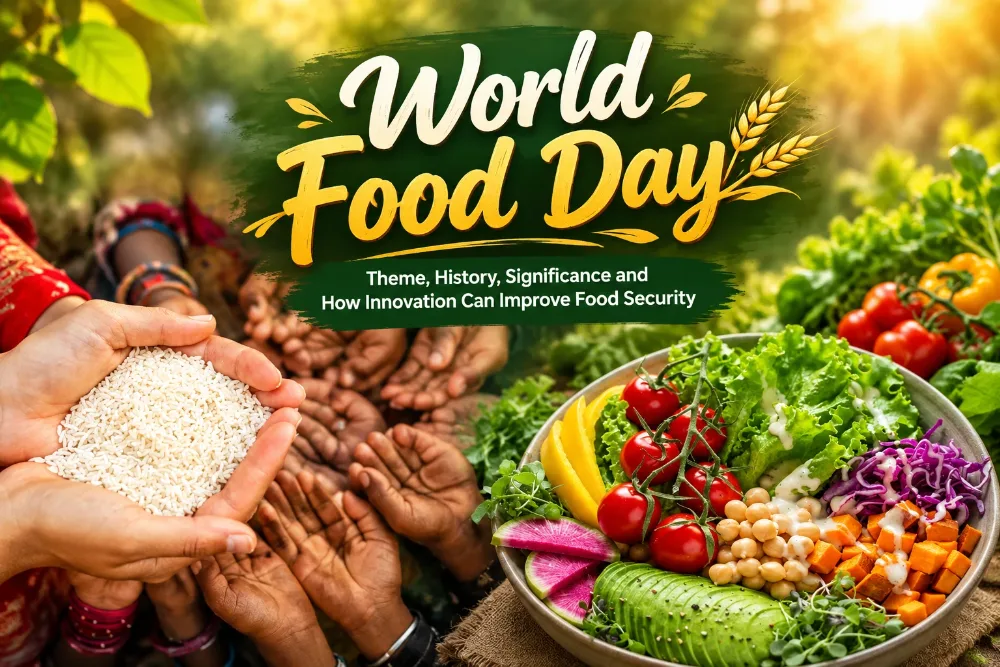
World Food Day is observed every year on 16 October, and the 2026 theme is “Innovate today. Nourish tomorrow.” Led by the Food and Agriculture Organization of the United Nations (FAO), the day makes one uncomfortable point: the world already grows enough food, yet around 645 million people faced hunger in 2025 and about 2.69 billion, nearly one in three, could not afford a healthy foods.
Have you ever wondered how that can be true? The answer has less to do with farms and more to do with access, affordability and the systems that move food from field to plate. This article walks through what the 2026 theme means, where the day came from, why it still matters, and how new ideas, from digital advice for farmers to an ant powered food waste experiment built by a teenager, can help close the gap.
What “Innovate Today. Nourish Tomorrow.” Really Asks of Us
The FAO chose this theme to make a simple connection: the ideas put to work now decide whether people will have enough good food in the years ahead. It is a call to act early rather than wait for the next emergency.
Hunger is a problem of access, not production
Because the world produces enough food, simply growing more does not solve hunger. The gap sits in who can reach food and who can afford it. Conflict, economic instability and climate shocks keep widening that gap, which is why the numbers above remain so stubborn.
Innovation is bigger than new gadgets
When you hear the word innovation, do you picture a drone over a field? The FAO uses the word far more broadly. It includes digital advisory services for farmers, improved seeds and biotechnology, and data systems. It also covers farmer field schools, cooperatives, traditional land and water management practices, and fresh approaches to finance, markets and distribution. An old practice that protects soil counts just as much as a new app.
Who gets a seat at the table
Farmers, fishers, herders and foresters sit at the centre of the idea. Women, youth and Indigenous Peoples bring knowledge built up over generations. Investors, policymakers and entrepreneurs are expected to work alongside them rather than around them.
Preventing a crisis costs less than answering one
Addressing risks before a crisis emerges builds resilience and costs far less than responding after the damage is done. This is a core principle of disaster risk reduction and climate adaptation, and it is the quiet logic behind the word “today” in the theme.
How an Anniversary in Rome Became a Global Observance
Why the date is 16 October
The FAO was founded on 16 October 1945 to improve nutrition, raise agricultural productivity and support rural communities. It is a specialised agency of the United Nations with its headquarters in Rome, and World Food Day marks the anniversary of its founding.
From a 1979 proposal to a UN endorsement
FAO member states established the observance in November 1979 at the organisation’s 20th General Conference, asking countries to mark it from 16 October 1981 and every year after. On 5 December 1980, the UN General Assembly endorsed the decision and urged governments and organisations at all levels to take part. Counting 1981 as the first, 2026 is the 46th observance, and a new theme is chosen each year to spotlight a different side of the food challenge.
What the day looks like now
The main programme takes place at FAO headquarters in Rome and is aimed at leaders and the press. Universities and UN bodies around the world run symposia, workshops and conferences of their own. Some years have also been tied to campaigns on single crops, such as the International Year of Rice in 2004 and the International Year of the Potato in 2008.
There is a grassroots side too. Initiatives like TeleFood fund small projects that help small scale farmers raise their productivity and income, and sponsored sports events, charity auctions, concerts and marches help raise money for the cause.
Zero Hunger by 2030: Where the Pressure Points Are
What the goal actually promises
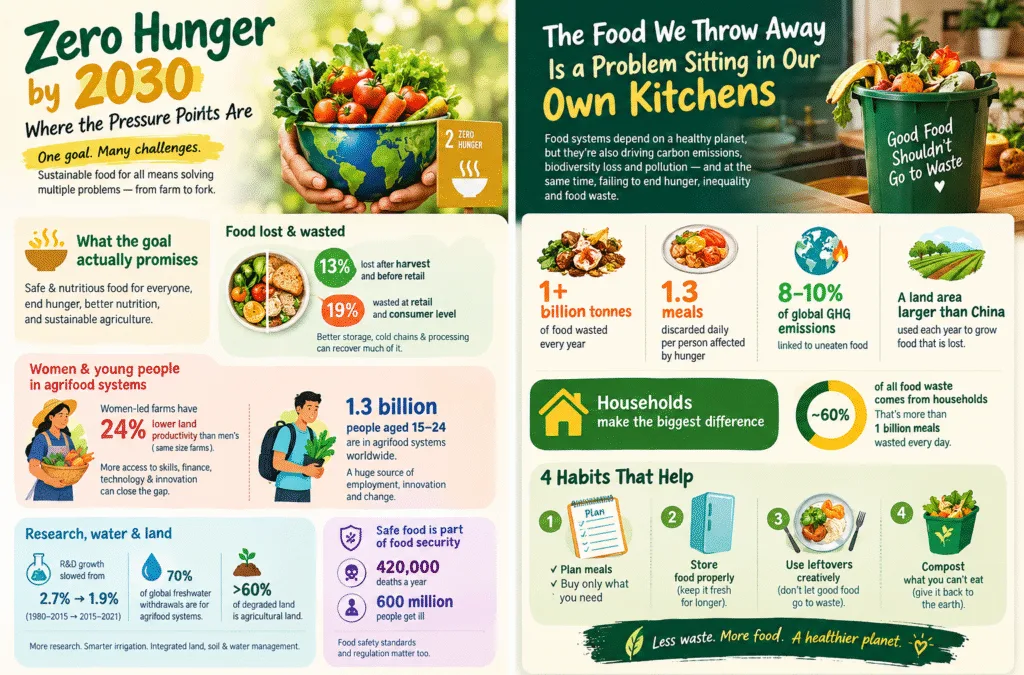
Sustainable Development Goal 2, known as Zero Hunger, means safe and nutritious food for everyone at all times. By 2030 it aims to end hunger, achieve food security and better nutrition, and promote sustainable agriculture. The figures below show how many separate problems sit underneath that single goal.
Food lost and food wasted
About 13% of food produced is lost after harvest and before it reaches retail. Another 19% is wasted at retail and consumer level. Better storage, cold chains and processing can recover much of it, which makes this one of the more practical places to start.
Women and young people in agrifood systems
Farms managed by women show 24% lower land productivity than men’s farms of the same size, mainly because women have less access to skills, finance, technology and innovation. Closing that gap is central to women’s empowerment. At the other end of the age range, around 1.3 billion people aged 15 to 24 are involved in agrifood systems worldwide, which makes young people a major source of employment, innovation and change.
Research, water and land
Agricultural research and development yields some of the highest returns among rural development investments, yet annual growth in agrifood R&D spending slowed from 2.7% between 1980 and 2015 to 1.9% between 2015 and 2021. Agrifood systems account for about 70% of global freshwater withdrawals, so smart farming and efficient irrigation matter a great deal. Over 60% of land degraded by human activity is agricultural land, which is why integrated management of land, soil and water is necessary for lasting food security.
Safe food is part of food security
Contaminated food causes roughly 420,000 deaths a year and makes about 600 million people ill. Food that exists but cannot be eaten safely does not feed anyone, so food safety standards and regulation belong in this conversation as much as yields and prices.
The Food We Throw Away Is a Problem Sitting in Our Own Kitchens
Food systems depend on a healthy planet, yet they are also a major driver of what the UN Environment Programme (UNEP) calls the triple planetary crisis: rising carbon emissions, biodiversity loss and pollution. At the same time they are failing at their main job, with more hunger, more inequality and more food wasted.
The scale of the waste is hard to picture. We throw away more than 1 billion tonnes of food every year, and each day consumers discard 1.3 meals for every person in the world affected by hunger. Estimates suggest 8 to 10 percent of global greenhouse gas emissions are linked to food that is never eaten, and a land area larger than China is used every year to grow food that is lost along supply chains.
Fixing this takes cooperation across the whole system, from public policy to agribusiness and retail. But households matter more than most people expect. Roughly 60 percent of all food waste comes from households, which is more than 1 billion meals wasted every day. Here are four habits that make a real difference.
Shop with a plan
Waste often starts with what we put in the trolley: food we never get around to eating, or impulse buys triggered by sales and marketing. Plan your meals before you go to the store and stick to your list. Check the fridge first so you do not buy more than you need or double up on something you already own.
Cook what you will actually eat
Cooking more than you can finish leads to leftovers that eventually get thrown out. Unless you are batch cooking, measure portions of rice and other staples so you prepare only what you or your group will eat in one sitting. When leftovers do appear, let them replace a meal you would otherwise buy, or fold them into a new recipe.
Store food where it will last
Knowing the storage needs of different foods cuts spoilage. Keep dry foods in airtight containers, fresh meat in the freezer or the chill compartment of the fridge, and onions and potatoes in a cool, dark place. Fresh fruit and vegetables belong in the vegetable drawer, and opened packaging should be sealed tightly. For anything perishable, use first in, first out, so the oldest items are eaten first.
Also read:
How to Get Groceries Delivered: The Complete 2026 Guide (Including What’s New)
Read date labels before you bin food
Many people assume food must be thrown out once the “best before” date passes. In the EU, 10 percent of annual food waste is linked to expiration dates, and in the U.S., 84 percent of consumers discard some food purely because of the label. The two labels mean different things. A “use by” date marks the point after which food is no longer safe to eat. A “best before” date only means the manufacturer can no longer guarantee peak quality, taste or texture, and food is often perfectly safe past that point. A quick look, a sniff and a taste will usually tell you what you need to know.
A Teenager, an Ant Colony and 83 Percent Efficiency
Innovation does not always arrive from a big laboratory. Ananya Gulur Nagendra, an 18 year old from Plano, Texas, studied how ant scavenging could break down human food waste. Her project, titled “Utilizing Ants Through Novel Aerobic Digester System for Anthropogenic Food Waste Decomposition,” was entered in the animal sciences category of the Regeneron Science Talent Search.
Know more about Ananya Gulur Nagendra
The ant inspired digester she built reached 83 percent efficiency in decomposing unwanted food. Her research focuses on reducing methane emissions from landfills, and it earned her a place as a finalist in the competition.
It is one student’s project, not a finished solution for the world’s waste. Still, it shows the spirit of this year’s theme: a fresh idea aimed at a real problem, started today in the hope of a better tomorrow.
Why One Day on the Calendar Still Matters
Hunger can be solved
Because enough food is produced worldwide, the gap lies in access, affordability and fair systems. That makes hunger a solvable problem, and the day keeps this fact in front of the public and policymakers.
Everyone has a job to do
Governments invest in research and rural infrastructure and set the policies that make progress possible. The private sector contributes investment, jobs and solutions that can scale. Research institutions, civil society, producer groups and UN agencies turn those solutions into action. No single group can do it alone.
Indigenous knowledge deserves recognition
Indigenous Peoples make up about 6% of the global population, yet they are among the most effective custodians of the world’s remaining biodiversity, thanks to food systems developed over generations. Innovation, in the FAO’s sense, includes learning from them.
What individuals can do
Choosing varied, nutritious diets, reducing food waste, protecting soil, water and biodiversity, and staying informed all help shape a more sustainable food system. Which of the kitchen habits above could you try this week?
A global observance, not a public holiday
Events take place in about 150 countries and up to 50 languages, involving governments, cities, businesses, civil society, media and young people. World Food Day is not a public holiday, so its reach depends on people choosing to take part.
Questions People Ask About World Food Day 2026
When is World Food Day 2026, and which observance is it?
It falls on 16 October 2026. Counting 1981 as the first year, this is the 46th observance.
Who organises World Food Day?
The Food and Agriculture Organization of the United Nations leads it. The FAO is a specialised UN agency headquartered in Rome, and the day marks the anniversary of its founding on 16 October 1945.
Is World Food Day a public holiday?
No. It is a global observance rather than a public holiday, with events held in about 150 countries and up to 50 languages.
If the world grows enough food, why do people still go hungry?
Because the problem is access and affordability, not production. Around 645 million people faced hunger in 2025, and about 2.69 billion could not afford a healthy diet. Conflict, economic instability and climate shocks make matters worse.
How does wasting food connect to hunger and climate?
UNEP estimates that consumers discard 1.3 meals every day for each person affected by hunger, and that 8 to 10 percent of global greenhouse gas emissions are associated with food that is never eaten. Less waste means more of the resources already spent on food actually feed people.
What does innovation mean in this year’s theme?
It covers new technology such as digital advisory services, improved seeds, biotechnology and data systems, but also farmer field schools, cooperatives, traditional land and water management, and new approaches to finance, markets and distribution.
Does a “best before” date mean food has gone off?
Not necessarily. A “use by” date marks when food stops being safe to eat, while “best before” refers to quality, taste or texture. Food is often safe past the “best before” date, so check how it looks, smells and tastes before deciding.
References
- 5 Facts About Food Waste and Hunger – World Food Programme
- World Food Day 2026 – Vajiram & Ravi
- Reducing Food Loss and Waste for a Healthier Planet – Geneva Environment Network
- Stories and News – World Wildlife Fund