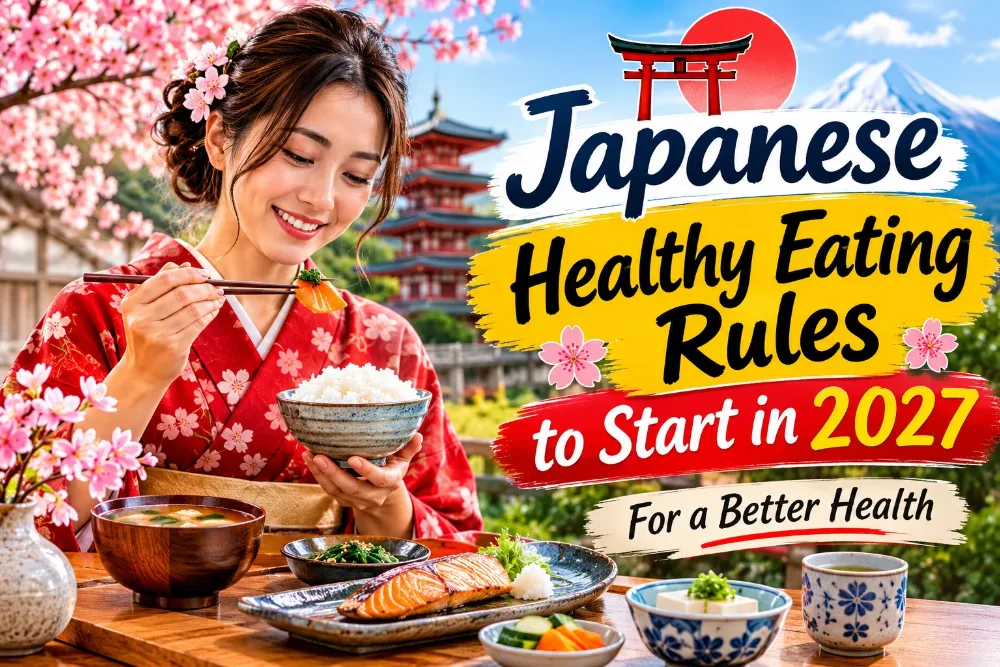
Japan’s healthy eating habits come down to a few repeatable rules. Eat until you are about 80 percent full, build meals from small dishes rather than one heavy plate, favor fish, rice, soy and vegetables over processed food, and avoid fast food, especially at night. None of this needs special ingredients. It is mostly a change in how you plan and pace a meal, and you can start it at your very next dinner.
Why Everyone Is Looking at Japan’s Diet Right Now
Japan recently crossed a milestone: more than 100,000 people in the country are centenarians, with 107,677 of them at least 100 years old. The country already has one of the highest life expectancies in the world, at 88 years for women and 81 years for men.
Proof: Japan surpassed 100,000 centenarians for the first time in September 2026
Researchers link this to several things working together: low obesity rates, healthy diets, widespread health screenings and affordable health care. Together these contribute to lower mortality from heart disease and cancer. Food is one piece of the puzzle, not the whole of it, but it is the piece you can change today.
Epidemiologist Jay Olshansky of the University of Illinois Chicago puts the milestone in perspective. Many older people today are living on time that physicians and public health work have made possible. He also cautions that a long life is only a good outcome when it comes with good health. So the real question is not just how to live longer, but how to eat in a way that supports feeling well along the way.
Stop Eating When You Are 80 Percent Full
The best known rule comes from Okinawa and is called Hara Hachi Bu. It means eating until you are about 80 percent full and deliberately leaving roughly 20 percent of your stomach empty. Savvy Tokyo, the source of these rules, says this habit may lower the risk of heart disease, cancer and stroke. It pairs best with foods that are low in calories and can be chewed finely.
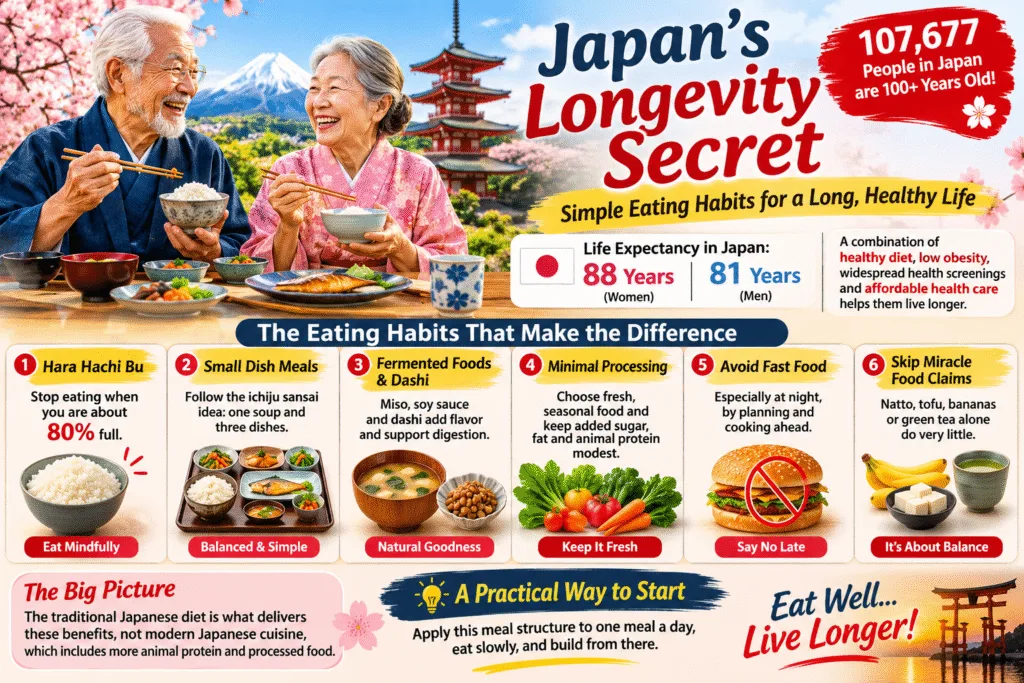
The infographic highlights Japan’s longevity milestone, six traditional Japanese eating habits, and a practical way to start eating healthier.
Think about the last time you finished a meal because the plate was empty, not because you were still hungry. Hara Hachi Bu asks you to notice the difference. Eating slowly gives you the chance to catch that point of comfortable fullness before it becomes too much.
Build the Meal Around Small Dishes
Traditional Japanese food follows a principle called ichiju sansai: one soup and three dishes, usually vegetables, rice and fish. The idea is balance, and it is why a Japanese meal rarely looks like a single large portion of one thing.
The traditional pattern, known as washoku, is a set of small dishes made from simple, fresh and seasonal ingredients. Researchers describing it generally break a meal into four parts;
- Staple: steamed rice, or soba, ramen or udon noodles
- Soup: often miso soup with seaweed, shellfish or tofu and vegetables, though vegetable or noodle soups are also common
- Main dish: fish, seafood, tofu or natto, with small amounts of meat, poultry or eggs if you like
- Sides: vegetables that are raw, steamed, boiled, sautéed, grilled or pickled, plus seaweed and fruit
Notice that meat is optional and small. Animal protein, added sugar and fat make up only a modest share of the traditional diet.
Let Fermented Foods and Dashi Do the Flavor Work
Fermented foods such as miso and soy sauce are valued in Japan for supporting digestion. Dashi, the savory soup broth, adds depth to a dish, which helps food taste satisfying without relying on heavy sauces. Your supplied source credits dashi with helping manage salt levels in the diet.
This connects to something distinctive about Japanese cooking. It aims to bring out the natural flavor of ingredients rather than cover it up. The rich savoriness known as umami, often called the fifth taste alongside sweet, salty, sour and bitter, occurs naturally in many of these foods and enhances vegetables and other nutritious ingredients. Natto is one of the staple foods in this tradition, and you can read more about it in Healthline’s guide to natto.
Skip Fast Food, Especially After a Long Day
Evening is when many people reach for convenience. After work or activities, the body is tired and hungry, and the easiest option is usually fast food heavy in fat, sugar and preservatives. The advice here is simple: before you eat, ask whether this is really a good meal for the end of the day.
The practical answer is to plan ahead. Cook for yourself when you can, or prepare something nutritious before you leave the house in the morning. A pot of miso soup and some cooked rice and vegetables will beat a drive through lane on a tired night.
Traditional Japanese Eating Versus Modern Japanese Eating
It helps to know that “Japanese food” is not one fixed thing. The traditional diet is built on minimally processed, seasonal foods and has a lot in common with the Okinawan diet, though it includes noticeably more rice and fish. Modern Japanese cuisine, by contrast, has strong Western and Chinese influences and includes more animal protein and processed foods.
So when people say the Japanese diet is healthy, they are mostly describing the traditional pattern. If you want the benefits, copy the washoku approach, not whatever happens to be served in a restaurant labeled Japanese.
Drinks, Snacks and Mealtime Habits
The traditional pattern comes with some quiet habits that are easy to overlook. Hot green tea or cold barley tea are the usual drinks. Alcohol such as beer and sake is typically kept for dinner. Snacks are uncommon and rarely eaten, which means meals do the real work of feeding you.
Food is also meant to look good. Dishes are served in small, attractive portions and eaten in small bites with chopsticks, which is believed to bring out a harmony of flavors. Chopsticks naturally slow you down, which fits neatly with the 80 percent rule.
Don’t Trust Miracle Foods
You will often see bananas, natto, umeboshi (pickled plums), tofu or green tea promoted as instant diet solutions. They are all part of everyday eating in Japan, but eating only these foods does very little on its own. The effect is small unless it comes with balanced meals, a positive mindset and regular exercise. The real benefit comes from the overall pattern, not from any single ingredient.
A Simple Way to Begin This Week
You do not need to overhaul your kitchen. Start with one meal a day and try the structure: a bowl of rice or noodles, a soup, one main dish of fish or tofu, and a vegetable side. Eat slowly, stop at about 80 percent full, and see how you feel an hour later. Then add a second meal when it feels natural.
Sources used:
- Scientific American: Can humans live forever?
- Healthline: What is the traditional Japanese diet?
- Healthline: Natto
- Healthline: Umami rich foods
- Healthline: Benefits of seaweed
- Research review on the Japanese diet, PubMed Central
- Research study on Japanese eating patterns, PubMed
Frequently Asked Questions
Is the Japanese diet the reason Japan has so many centenarians?
Not by itself. Researchers point to a combination of low obesity rates, healthy diets, widespread health screenings and affordable health care, all of which help reduce deaths from heart disease and cancer. Diet is one important factor among several.
What does Hara Hachi Bu mean in everyday terms?
It means stopping when you feel about 80 percent full, leaving a little room in your stomach. It originated in Okinawa and is linked in the source material to a lower risk of heart disease, cancer and stroke.
What does a typical traditional Japanese meal include?
A staple such as rice or noodles, a soup, a main dish like fish, tofu or natto, and a few vegetable or seaweed sides. Meat, poultry and eggs appear only in small amounts.
Do I need to eat Japanese ingredients to follow this approach?
The principles matter more than the exact ingredients. Small portions, variety, minimally processed food, plenty of vegetables and less added sugar and fat are the core ideas, and you can apply them with foods available where you live.
Can I lose weight by eating natto, tofu or green tea?
These foods are common in Japan, but eating them alone will have only a small effect. They work best as part of balanced meals, together with a positive mindset and exercise.
How is the traditional Japanese diet different from the Okinawan diet?
They are similar, but the traditional Japanese diet includes significantly more rice and fish. You can read more in Healthline’s overview of the Okinawan diet.
Should I eat snacks while following Japanese eating habits?
Snacking is uncommon in the traditional pattern, so most food comes in proper meals. If you do snack, the same guidance applies: choose fresh, minimally processed foods over fast food or sugary options.
About The Author
