
Watch any marathon or football match closely. You’ll spot athletes chugging pickle brine mid cramp. This isn’t a strange trend. Pickle juice has become a trusted recovery tool. The reason why might surprise you.
For years, people assumed it was about sodium. Turns out that’s only half the story.
The Real Reason: It’s Not About Electrolytes, It’s About Nerves
A muscle cramp isn’t usually caused by low sodium in that moment. It happens when nerves misfire. They send nonstop contraction signals to a tired muscle.
This is where pickle juice gets clever. It hits the back of your mouth and throat fast. The vinegar and salt combination acts as a “tastant.” This is a flavor sharp enough to interrupt your nervous system. That signal travels to your spinal cord. It tells the misfiring nerve to stop.
That’s why it works so quickly. Sodium usually takes fifteen to twenty minutes to digest and absorb. Pickle juice relieves cramps in just 30 to 80 seconds. That’s roughly 40 percent faster than water. You don’t even need to swallow it. Swishing it for 20 to 30 seconds triggers the same reflex.
Once your gut catches up, sodium and potassium take over. They replace what sweat has washed away.
Five Real Benefits of Pickle Juice
Pickle juice contains more sodium than most sports drinks. That makes it especially useful after long, hot training sessions. Here are the top 5 benefits.
1. It supports athletic performance
Many athletes now carry a small bottle of brine. The flavor is intense, so most people sip small amounts. Pair it with regular water during your workout.
2. It genuinely hydrates
Sodium pulls water into your cells. This helps you hold onto fluids before and after training. It’s a supplement, not a replacement for water. The NIH still recommends around 9 cups daily for women. Men should aim for about 13 cups.
3. It may ease a hangover
Alcohol strips your body of potassium and salt. Pickle juice’s sodium and water combo can help restore that balance. It isn’t scientifically proven as a cure. Plenty of people still swear by it.
4. It might calm muscle cramps beyond sports too
Researchers aren’t fully sure what causes the effect. It could be the acetic acid at work. Study results across trials have been mixed so far.
5. It can soothe an upset stomach
Pickle juice is a fermented food. It carries probiotics, the good bacteria your gut needs. This can help with digestive discomfort or IBS symptoms.
Related search:
What About the Cortisol Trend?
Social media has pitched pickle juice as a cortisol lowering hack. Take that claim with a grain of salt. Gena Hamshaw, RDN at Mount Sinai, has weighed in. She says no clinical trials support that specific link. The trend is running ahead of the science. It may still help through cramp relief or hydration. Just don’t expect it to fix your stress levels.
Nutrition Facts: What’s in an 8 Ounce Serving
| Nutrient | Amount |
|---|---|
| Calories | 0 |
| Fat | 0g |
| Sodium | 821mg |
| Carbohydrates | 0g |
| Fiber | 0g |
| Added sugars | 0g |
| Protein | 0g |
Pickle juice is basically zero calorie salt water with flavor. That’s exactly why it works as a fast fix. You get electrolytes without the sugar crash of typical sports drinks.
Also read:
Even the Referees Are Drinking It
Pickle juice’s reputation grew during the 2026 FIFA World Cup. Referee Felix Zwayer reportedly used it to fight cramping. This happened late in USA’s 2-0 win over Australia in Seattle. If it keeps a World Cup official running for 90 minutes, the hype seems earned.
How to Make Your Own Pickle Juice at Home
You don’t need leftover jar brine for this. Homemade pickle juice is simple and cheap. It also lets you control the sodium content.
Prep time is 5 minutes.
Cook time is 10 minutes.
This recipe yields about 3 cups.
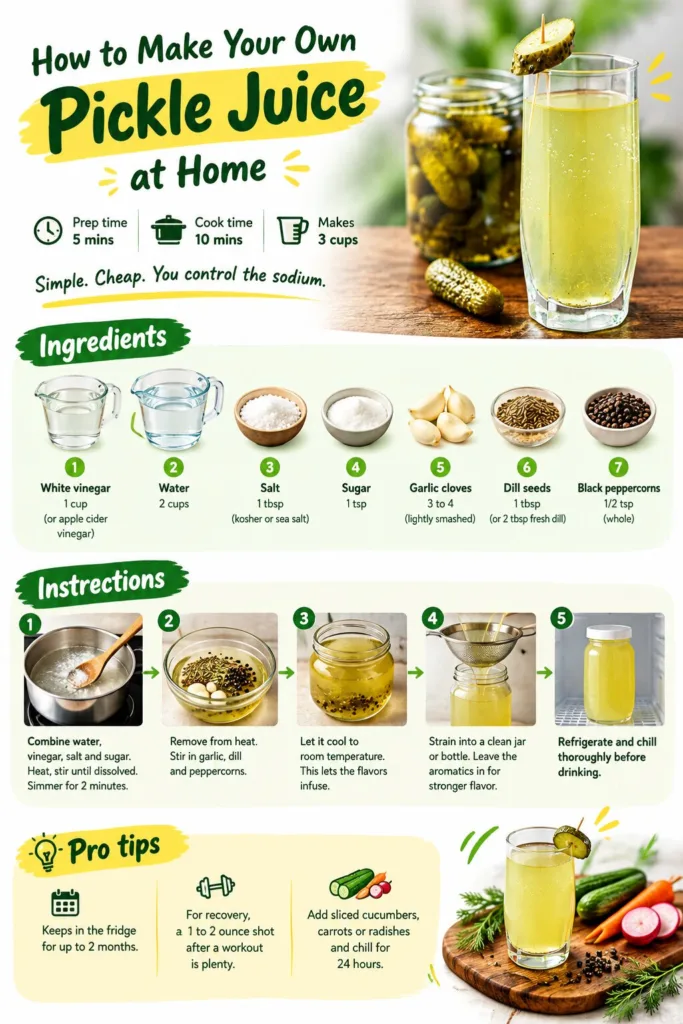
Ingredients:
- 1 cup white vinegar (or apple cider vinegar for fruitier flavor)
- 2 cups water
- 1 tablespoon kosher or sea salt (skip iodized salt, it clouds the brine)
- 1 teaspoon white sugar
- 3 to 4 garlic cloves, lightly smashed
- 1 tablespoon dill seeds (or 2 tablespoons fresh dill)
- Half a teaspoon whole black peppercorns
Instructions:
- Combine water, vinegar, salt, and sugar in a saucepan. Heat on medium and stir until dissolved. A gentle simmer for 2 minutes is enough.
- Remove from heat. Stir in the garlic, dill, and peppercorns.
- Let the mixture cool to room temperature. This lets the flavors fully infuse.
- Strain into a clean jar or bottle. You can leave the aromatics in for stronger flavor.
- Refrigerate and chill thoroughly before drinking.
Pro tips:
- It keeps in the fridge for up to 2 months.
- For recovery, a 1 to 2 ounce shot after a workout is plenty.
- Add sliced cucumbers, carrots, or radishes and chill for 24 hours.
How to Fit Pickle Juice Into Your Routine
A daily habit is fine within limits. Stay under 2,300 milligrams of sodium per day. Keep it to 1,500 milligrams if you have high blood pressure. Sodium content varies by brand, so check labels first.
A few easy ways to use it:
- Sip a small shot before a tough workout
- Swap it in for vinegar in salad dressing
- Keep a bottle in your gym bag for emergencies
Bottom line
Pickle juice isn’t just an old wives’ tale. It’s a fast acting cramp reliever backed by real science. It’s also a genuinely useful sodium source for hard training. Just don’t expect it to fix your cortisol. For more interesting food blog visit recipe to cook website.