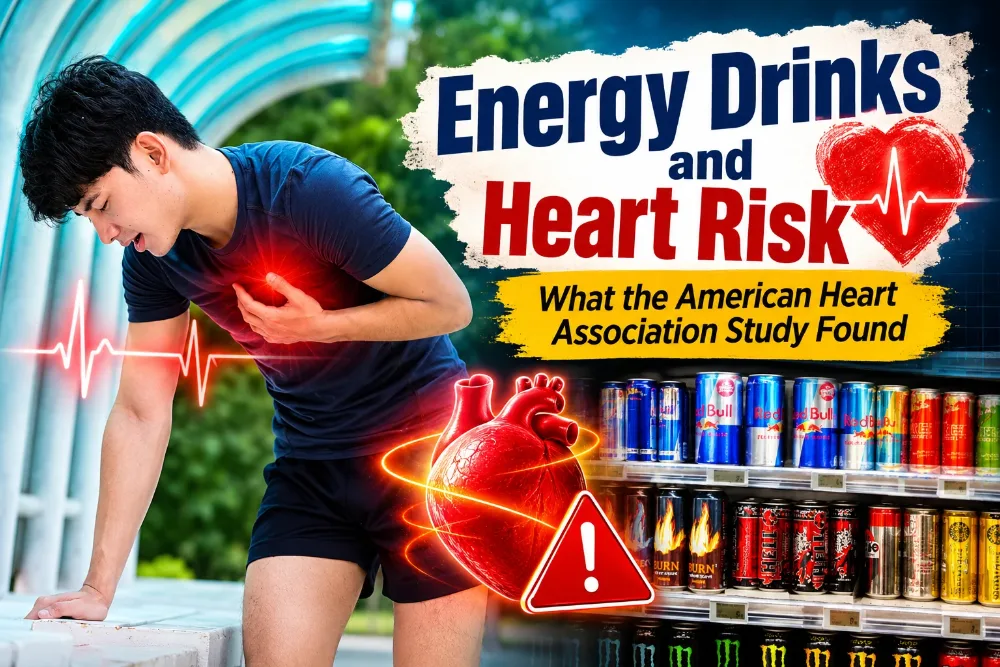
Yes, the American Heart Association has released preliminary research linking caffeinated energy drinks and stimulant supplements to a far larger share of serious heart related reports, including cardiac arrest and heart attack, particularly among adults aged 18 to 34. The catch is just as important as the headline: the study shows an association, not proof that these products caused any of the events.
That distinction deserves more attention than it usually gets. Adults in their late teens, twenties and early thirties are rarely seen as a cardiovascular risk group, yet they accounted for about 45% of the reports tied to heart events in this analysis.
Have you ever stopped to think about how much caffeine is actually in the can you reach for before a workout or a long day?
The findings come from a research abstract, which means they have not been through peer review. Below, we go through what the American Heart Association’s preliminary research reported, why caffeine content is central to the discussion, and what the data cannot tell us.
What the researchers looked at, and what they found
The team reviewed 28,345 reports submitted to the US Food and Drug Administration between 2017 and 2025. Of those, 854 involved energy drinks or dietary supplements containing caffeine or other stimulants. The question was simple: when a report involved one of these products, how often did it also describe a serious heart problem, compared with reports about products that contain no such ingredients?
Also read:
Can Diet Soda Help You Lose Weight? A Two Year Trial Surprised
How much more often each condition appeared
Cardiac arrest stood out most. It showed up about 11 times more often in reports involving stimulant containing products. The other conditions followed a similar direction, though with smaller gaps:
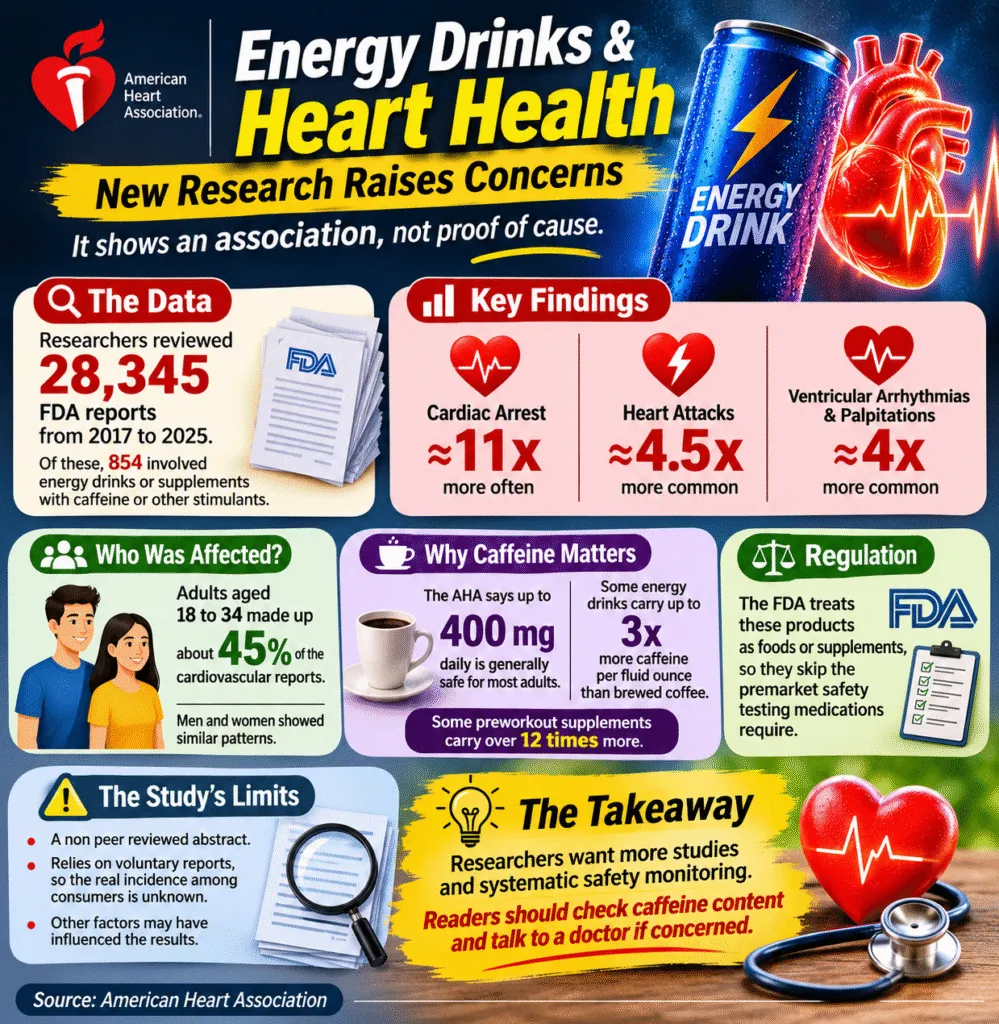
- Heart attack: about 4.5 times more often
- Ventricular arrhythmias, meaning abnormal rhythms in the heart’s lower pumping chambers, and heart palpitations: about 4 times more often
- Elevated heart rate: nearly 3 times more often
- Chest pain: 2.71 times more often
- Fainting: about 2 times more often
What a reporting ratio really means
It helps to be precise about what is being compared here. These figures describe how often certain conditions appeared inside a pool of reports. They do not describe how often people who drink energy drinks or take stimulant supplements end up with heart trouble. That second number would require knowing how many people use these products, and a database of reports cannot supply it.
Why adults aged 18 to 34 draw so much attention
About 45% of the reports linking these products to cardiovascular events involved adults between 18 and 34. This is the detail that made the study stand out, because cardiac arrest and heart attack are not what most people associate with this age group.
Men and women showed the same pattern
The researchers saw similar patterns in reports involving men and women, so the signal did not appear to belong to one sex alone.
A number that needs careful handling
Does a 45% share mean young adults are the most vulnerable? Not necessarily. The study does not say how many people in each age group actually use these products, so a large share of reports could simply reflect who is buying and consuming them.
 What the figure does tell us is that a large portion of the reports involve adults who are not usually considered at high risk, and that is reason enough for researchers to want a closer look.
Caffeine content: the part of the story that explains the concern
The researchers and the heart association both point toward one factor: how much caffeine and other stimulant these products can deliver. The study itself cannot say whether the ingredients are responsible, but the context around it explains why the question is being asked.
What the 400 milligram guideline means
According to the association’s 2026 scientific statement on caffeine and cardiovascular disease, up to 400 milligrams of caffeine a day is generally safe for most adults. That is roughly the amount in five 8 ounce cups of regular black coffee.
Why energy drinks and supplements are a different matter
The same statement notes that some energy drinks contain as much as three times more caffeine per fluid ounce than brewed coffee, and some preworkout supplements contain more than twelve times as much. Because that is a measure of concentration, the total in any one serving depends on its size, but the gap shows how quickly a concentrated product can change the math.
A regulatory gap worth knowing about
The US Food and Drug Administration regulates energy drinks and stimulant supplements as foods or dietary supplements, not as medications. As a result, they do not go through the premarket safety testing that medications require. That helps explain why researchers lean on adverse event reports to learn about their effects, and why they are asking for more systematic safety monitoring.
Gregory M. Marcus, who chaired the 2026 statement, said the findings raise concern that products with very high caffeine levels may harm the cardiovascular system. He added that there are biological reasons such a link could exist, while stressing that the study cannot prove it.
Also read:
The Top Five Foods Your Heart Craves, According to a New Study
What this study cannot tell us
Good science is as much about limits as findings, and this study comes with several.
The findings are preliminary
The work is a research abstract presented at an American Heart Association scientific meeting. Abstracts of this kind are not peer reviewed, and the findings count as preliminary until they appear as a full manuscript in a peer reviewed journal. Until then, the numbers could be refined or interpreted differently.
Voluntary reports have blind spots
The analysis relied on submissions that people chose to send to the FDA. That means it captures only what someone decided to report, and it cannot reveal how common these events are among everyone who uses energy drinks or stimulant supplements. The overall incidence among consumers remains unknown.
Association is not causation
The researchers were clear that their findings point to a link, not a cause. Marcus, who was not involved in the study, said that other factors may have influenced the results and that more research is needed to learn whether these stimulant products are truly responsible. The authors also called for further studies and for systematic safety monitoring of these products.
Reading the findings with a level head
It would be easy to take this study as a verdict on energy drinks. It is better understood as a warning light that tells researchers where to look next. The supplied evidence supports a narrower and more useful takeaway: caffeine content varies enormously between products, and a concentrated drink or supplement can carry far more per fluid ounce than a cup of coffee.
The heart association’s 400 milligram benchmark gives readers a reference point for most adults. Checking how much caffeine a product contains, and how that compares with the amount you already get from coffee or tea, is a sensible habit that does not depend on this study being proven right or wrong. Anyone with concerns about their own heart health should raise them with a doctor, since a news report cannot account for individual circumstances.
What would change the picture? Peer reviewed publication of the full analysis, and research that can measure how many people actually use these products, would both help show whether the link holds.
Questions readers often ask about the study
Does the study prove that energy drinks cause cardiac arrest?
No. The researchers described an association only, and the analysis relied on voluntary reports rather than a controlled comparison of consumers. Other factors may have influenced the results.
Has this research been peer reviewed?
Not yet. It is a research abstract, and abstracts presented at American Heart Association scientific meetings are not peer reviewed. The findings are considered preliminary until published as a full manuscript in a peer reviewed journal.
How much caffeine does the American Heart Association consider generally safe?
Its 2026 scientific statement says up to 400 milligrams a day is generally safe for most adults, about the same as five 8 ounce cups of regular black coffee.
Why are energy drinks and stimulant supplements not tested like medications?
The FDA regulates them as foods or dietary supplements instead of medications, so they do not face the premarket safety testing that medications go through.
Who is Gregory Marcus, and was he part of this study?
Marcus chaired the 2026 American Heart Association scientific statement on caffeine and cardiovascular disease and is a professor of medicine at the University of California, San Francisco. He was not involved in this study, which makes his comments an outside expert view rather than the authors’ own.
Can the study tell me how likely I am to have a heart problem from an energy drink?
No. Because it draws on reports and not on a count of everyone who uses these products, the overall incidence among consumers is unknown.