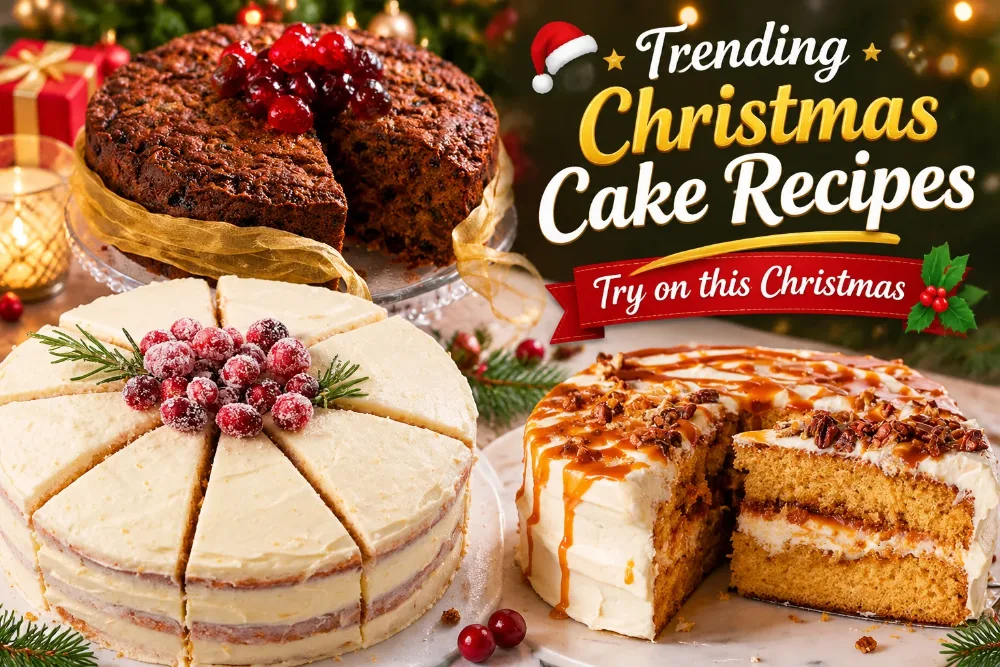
If you’re baking just one cake this Christmas, choose what suits you best.
Try Jamaican Christmas cake for rich, rum-soaked tradition and warming spices inside. Choose cranberry cake when you want something quick, fresh, and beautifully bright.
Mulled wine cake makes a lovely centrepiece, topped with wintery frosting too. Chocolate chip cake with ganache always makes a crowd-pleasing Christmas dessert choice.
Burnt sugar caramel cake brings deep toffee flavour to each delicious slice. All five recipes follow, with ingredients and easy steps to guide you.
The real difference between them is time. The Jamaican cake asks you to soak fruit for days and then bakes for up to two and a half hours. The cranberry cake is in and out of the oven in under fifty minutes.
The mulled wine cake is broken into three short stages of 15, 25 and 10 minutes. Which of those sounds most like your kitchen on the 24th of December?
Quantities are given in both US and metric measures, and oven temperatures in both Fahrenheit and Celsius, so you can follow along wherever you bake.
1. Jamaican Christmas Cake: Dark, Spiced and Soaked in Rum
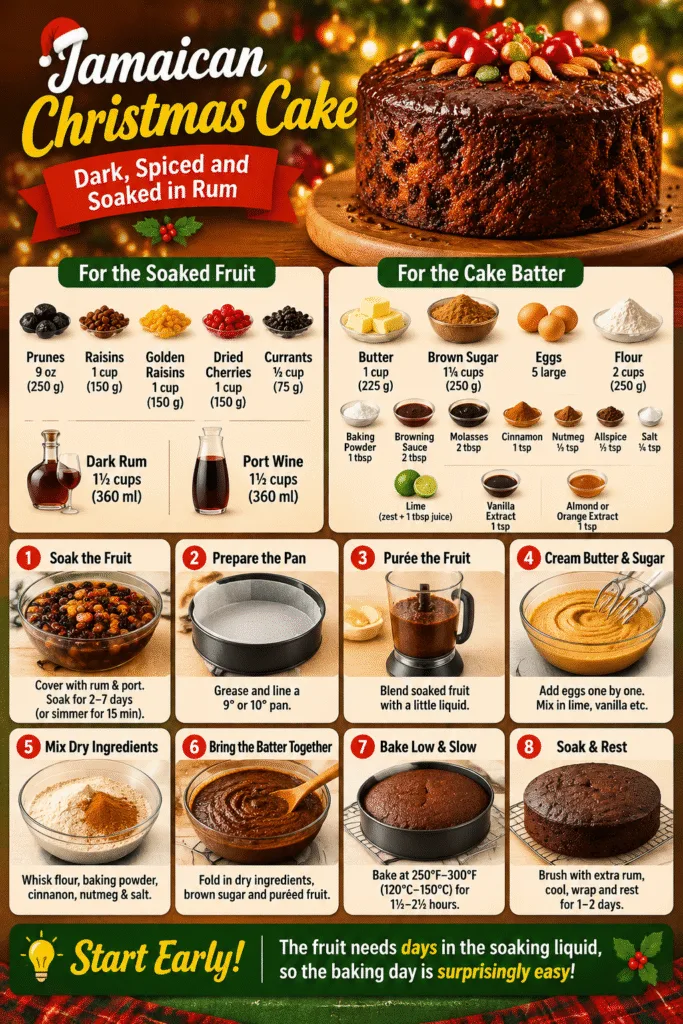
Jamaican Christmas cake is a rich, dark fruit cake. Dried fruits steep in rum and wine, get puréed, and are then folded into a spiced batter with browning syrup. Puréeing matters more than it sounds: the fruit becomes part of the crumb instead of sitting in it in chunks, which is how the whole cake ends up evenly dark and smooth.
What You Need for the Jamaican Cake
This makes one 9 inch or 10 inch cake.
For the soaked fruit:
- 9 oz (250 g) pitted dried prunes
- 1 cup (150 g) raisins
- 1 cup (150 g) golden raisins (sultanas)
- 1 cup (150 g) dried cherries
- ½ cup (75 g) currants
- 1½ cups (360 ml) dark rum, plus extra for soaking and feeding the cake
- 1½ cups (360 ml) port wine or sweet red dessert wine
For the cake batter:
- 1 cup (225 g) unsalted butter, softened
- 1¼ cups (250 g) dark brown sugar
- 5 large eggs, at room temperature
- 2 cups (250 g) all purpose flour
- 1 tbsp baking powder
- 2 tbsp browning sauce, or dark caramelised sugar syrup
- 2 tbsp molasses
- 1 tsp ground cinnamon
- ½ tsp freshly grated nutmeg
- ½ tsp ground allspice
- ¼ tsp salt
- 1 medium lime, zest plus 1 tbsp juice
- 1 tsp vanilla extract
- 1 tsp almond or orange extract
How to Make It, Step by Step
- Soak the fruit. Put the prunes, raisins, golden raisins, cherries and currants in a large container. Pour over the rum and port until the fruit is submerged. Cover and leave for at least 2 to 7 days, or up to several months, topping up with more rum or wine whenever the fruit is no longer covered. If you are short on time, simmer the fruit and liquid over low heat for 15 minutes and let it cool completely.
- Prepare the oven and pan. Heat the oven to between 250°F and 300°F (120°C to 150°C). Grease a 9 inch or 10 inch round or springform pan and line the base with parchment paper.
- Purée the fruit. Blend the soaked fruit with a few tablespoons of its soaking liquid until it forms a smooth, thick paste. Set it aside.
- Cream the butter and sugar. Beat the butter and dark brown sugar until light and fluffy. Add the eggs one at a time, beating well after each. If the mixture starts to curdle, add 1 tbsp of flour. Stir in the lime zest, lime juice, vanilla and almond or orange extract.
- Mix the dry ingredients. Whisk the flour, baking powder, cinnamon, nutmeg, allspice and salt together in a separate bowl.
- Bring the batter together. Gently fold the dry ingredients into the creamed mixture until just combined. Then fold in the browning sauce, molasses and puréed fruit until the batter is dark and even.
- Bake low and slow. Spoon the batter into the pan and smooth the top. Bake for 1½ to 2½ hours, depending on your oven and pan, until a toothpick in the centre comes out clean or with moist crumbs.
- Soak and rest. Let the cake cool a little, then brush or spoon extra rum or port over it. Cool completely, wrap tightly, and leave it for at least 1 to 2 days before slicing so the flavours settle together.
Because the fruit needs days in the soaking liquid, this is the one cake on the list you cannot leave to the last minute. Start it early and the work on baking day is surprisingly light.
Also try:
2. Classic Cranberry Christmas Cake for the Baker Short on Time
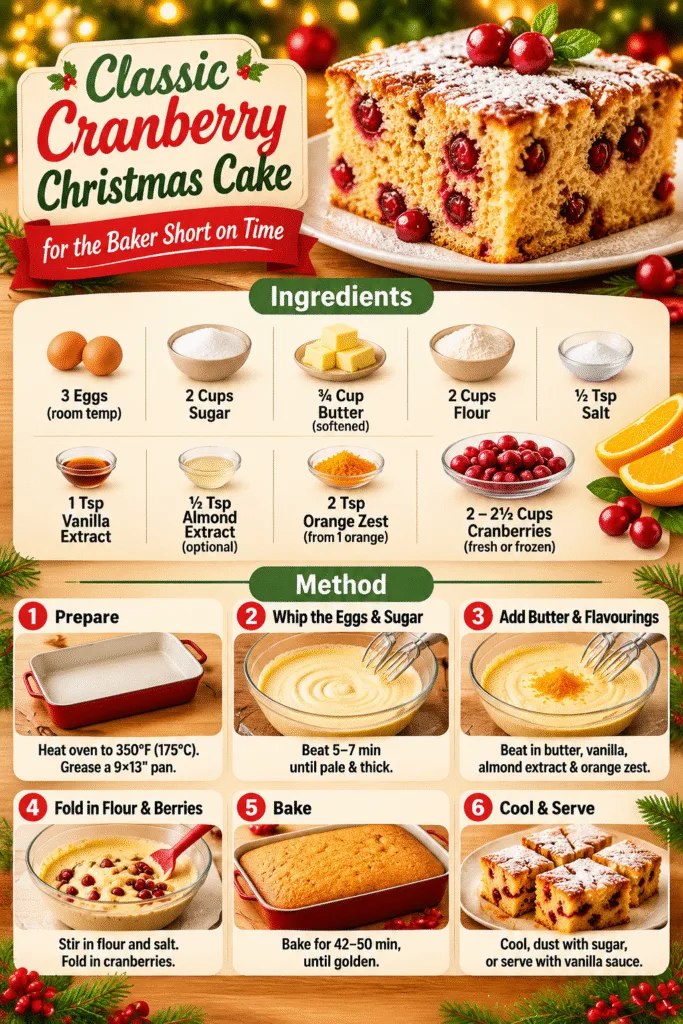
This cake starts by whipping eggs and sugar until thick and pale, then folds in softened butter, orange zest, flour and whole cranberries before baking in a 9 by 13 inch pan at 350°F (175°C) for 42 to 50 minutes. The ingredient list has no baking powder, so the volume you whip into the eggs and sugar is what keeps the cake from turning dense. Do not rush that first stage.
Cranberry Cake Ingredients
- 3 large eggs, at room temperature
- 2 cups granulated sugar
- ¾ cup unsalted butter, softened
- 2 cups all purpose flour
- ½ teaspoon kosher salt
- 1 teaspoon vanilla extract
- ½ teaspoon almond extract (optional)
- 2 teaspoons fresh orange zest, from about 1 orange
- 2 to 2½ cups fresh or frozen whole cranberries (do not thaw if frozen)
Method for the Cranberry Cake
- Prepare. Heat the oven to 350°F (175°C). Grease a 9 by 13 inch baking dish or line it with parchment paper.
- Whip the eggs and sugar. Beat them on medium high speed for 5 to 7 minutes, until pale, thick and doubled in volume.
- Add the butter and flavourings. Beat in the softened butter, vanilla, almond extract if you are using it, and the orange zest for 2 to 3 minutes, until combined.
- Fold in the flour and berries. Stir in the flour and salt just until combined, because overmixing is the main thing to avoid here. Fold in the cranberries by hand so they stay whole.
- Bake. Spread the thick batter evenly in the pan and bake for 42 to 50 minutes, until the top is golden brown and a toothpick in the centre comes out clean.
- Cool and serve. Let it cool completely before cutting into squares. Dust with powdered sugar, or serve with a warm vanilla butter sauce if you like.
It is a simple cake, and that is the appeal. Frozen cranberries go straight into the batter without thawing, so it is also an easy one to make when fresh berries are out of season.
Give a try:
3. Mulled Wine Cake with a Blush Pink Mascarpone Frosting
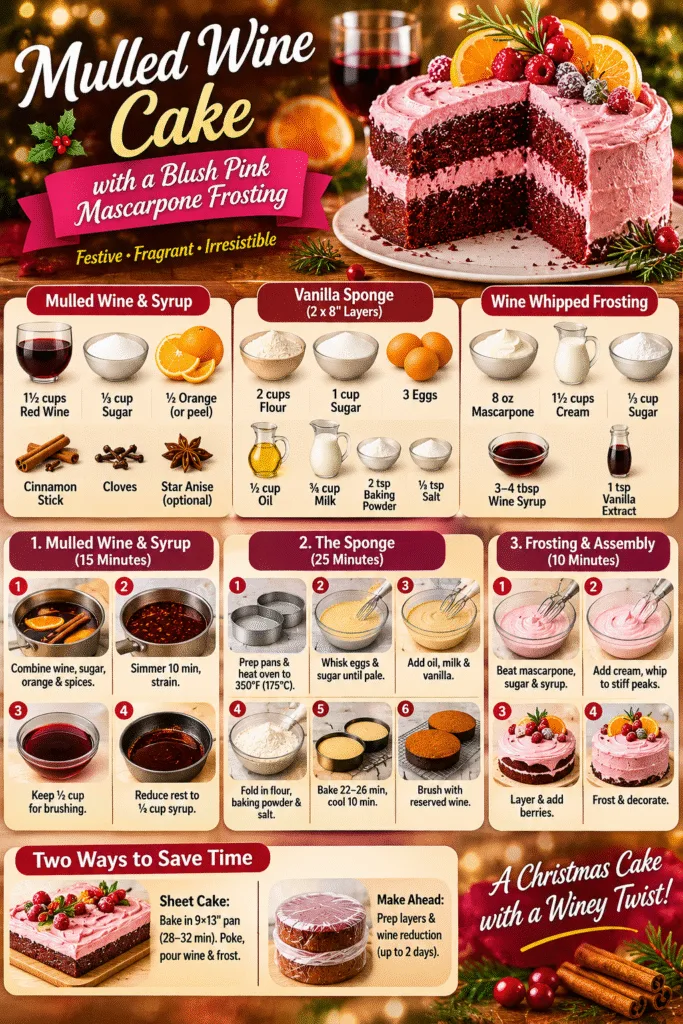
This version simplifies the traditional method. The sponge is mixed in one bowl, with no double boiler and no delicate egg whipping, and it is paired with a quick frosting made from mascarpone and cream that holds its shape without gelatin.
The flavour comes from mulled wine, red wine simmered with sugar, orange, cinnamon, cloves and star anise, which is used twice: brushed over the sponge and reduced into a syrup for the frosting.
You may also like mulled wine jam recipe
Ingredients for the Mulled Wine Cake
For the mulled wine and syrup:
- 1½ cups (360 ml) red wine, such as Merlot or Cabernet Sauvignon
- ⅓ cup (65 g) granulated sugar
- ½ orange, sliced, or 2 strips of orange peel
- 1 cinnamon stick
- 3 whole cloves
- 1 star anise pod (optional)
For the vanilla sponge (two 8 inch layers):
- 2 cups (240 g) all purpose flour
- 2 tsp baking powder
- ¼ tsp salt
- 1 cup (200 g) granulated sugar
- 3 large eggs, at room temperature
- ½ cup (120 ml) neutral oil, such as canola, sunflower or vegetable
- ¾ cup (180 ml) whole milk, at room temperature
- 2 tsp vanilla extract
For the wine whipped frosting:
- 8 oz (225 g) cold mascarpone, or full fat cream cheese softened slightly
- 1½ cups (360 ml) cold heavy whipping cream
- ⅓ cup (40 g) powdered sugar
- 3 to 4 tbsp cooled mulled wine reduction, from above
- 1 tsp vanilla extract
Stage One: The Mulled Wine and Syrup (15 Minutes)
- Combine the wine, sugar, orange, cinnamon, cloves and star anise in a small saucepan.
- Simmer gently over medium low heat for 10 minutes so the spices infuse, then strain out the solids.
- Pour ½ cup of the warm mulled wine into a small bowl. This is for brushing onto the cake later.
- Simmer the rest in the pan for 5 to 7 minutes, until it reduces to about ¼ cup of thick, glossy syrup. Let it cool completely.
Stage Two: The Sponge (25 Minutes)
- Heat the oven to 350°F (175°C). Grease two 8 inch round pans and line the bases with parchment paper.
- In a large bowl, whisk the eggs and sugar for 1 to 2 minutes, until pale and slightly frothy.
- Whisk in the oil, milk and vanilla until smooth.
- Sift in the flour, baking powder and salt. Fold gently with a spatula until no dry streaks remain, and stop there.
- Divide the batter between the pans and bake for 22 to 26 minutes, until the tops spring back lightly and a toothpick comes out clean.
- Cool in the pans for 10 minutes, then turn out onto a wire rack. Once completely cool, brush the tops with the reserved ½ cup of mulled wine.
Stage Three: The Frosting and Assembly (10 Minutes)
- In a chilled bowl, beat the cold mascarpone, powdered sugar, vanilla and 3 tbsp of the cooled syrup on medium speed until completely smooth.
- With the mixer on low, slowly pour in the cold cream. Then raise the speed to medium high and whip for 2 to 3 minutes, until stiff, fluffy peaks form. Add the extra tablespoon of syrup for a stronger wine flavour and a deeper blush colour.
- Place one soaked layer on a plate and spread a generous layer of frosting on top. Sliced strawberries, raspberries or other berries can go in here if you like.
- Add the second layer, frost the top and sides, and finish with orange slices, cinnamon sticks or fresh berries.
Two Ways to Save Time
For a sheet cake, bake all the batter in a single 9 by 13 inch pan for 28 to 32 minutes. Poke holes in the warm cake with a fork, pour the mulled wine over the top, and spread the frosting straight onto it.
To get ahead, the sponge layers and the wine reduction can both be made up to 2 days early and kept in the fridge. Whip the frosting and assemble on the day.
4. Chocolate Chip Cake with a Ganache Drip for the Centrepiece Table
This one pairs a soft, tender vanilla cake dotted with mini chocolate chips with a sweet buttercream with more mini chocolate chips folded in and a glossy ganache drip down the sides. It is built in three 8 inch layers, so it looks tall and impressive on a dessert table without any difficult technique.
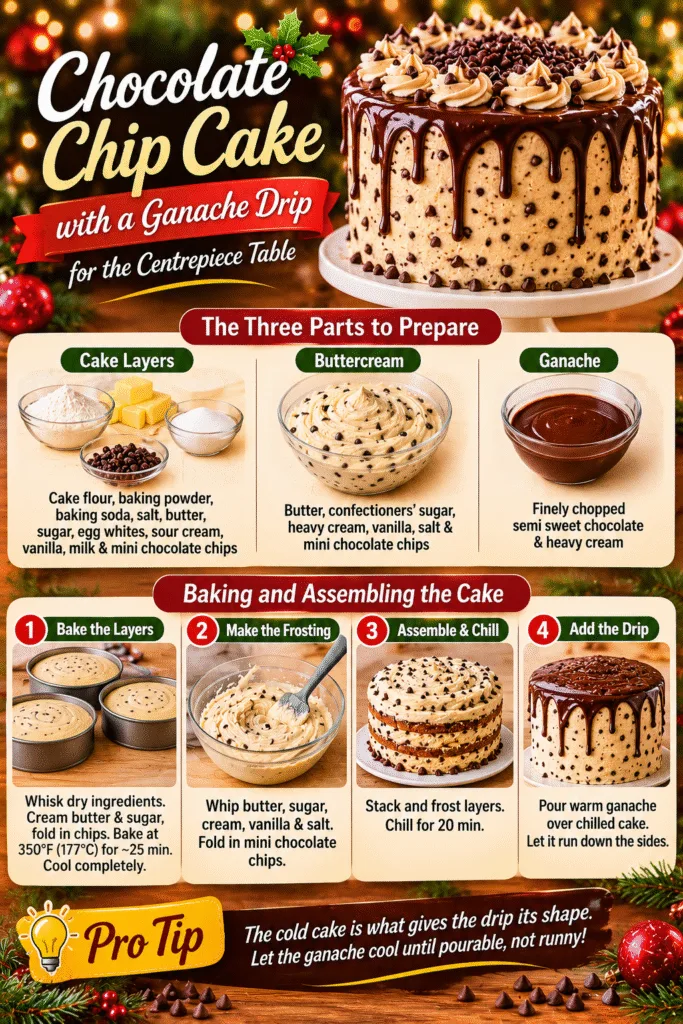
The Three Parts to Prepare
The cake itself uses cake flour, baking powder, baking soda, salt, unsalted butter, granulated sugar, egg whites, sour cream, vanilla extract, whole milk and mini chocolate chips tossed in flour. Tossing the chips in a little flour is the usual way to help them stay spread through the batter instead of settling at the bottom.
The buttercream is made from unsalted butter, confectioners’ sugar, heavy cream, vanilla, salt and more mini chocolate chips.
The ganache needs only two things: finely chopped semi sweet chocolate and heavy cream.
Baking and Assembling the Cake
- Bake the layers. Whisk the dry ingredients together. Cream the butter and sugar, then mix in the wet ingredients and fold in the floured mini chocolate chips. Divide the batter between three 8 inch pans and bake at 350°F (177°C) for roughly 25 minutes. Cool completely.
- Make the frosting. Whip the butter and confectioners’ sugar with the cream, vanilla and salt until fluffy, then fold in the mini chocolate chips.
- Assemble and chill. Stack and frost the cooled layers, then chill the cake for 20 minutes so the frosting firms up.
- Add the drip. Pour hot heavy cream over the chopped chocolate and stir until smooth and warm. Let it cool until it is pourable but not runny, then spoon it over the edge of the chilled cake so it runs down the sides.
The cold cake is what gives the drip its shape. Ganache that is too warm will slide straight off, so be patient and test it on the side of the cake before you commit.
5. Burnt Sugar Caramel Cake with a Toffee Depth
Despite the name, burnt sugar caramel cake tastes of toasted caramel, not of anything charred or bitter, as long as you stop the syrup at a deep amber colour. That syrup is sugar cooked until it caramelises and then loosened with boiling water, and it goes into both the cake batter and the frosting. Using it twice is what makes the flavour run all the way through.
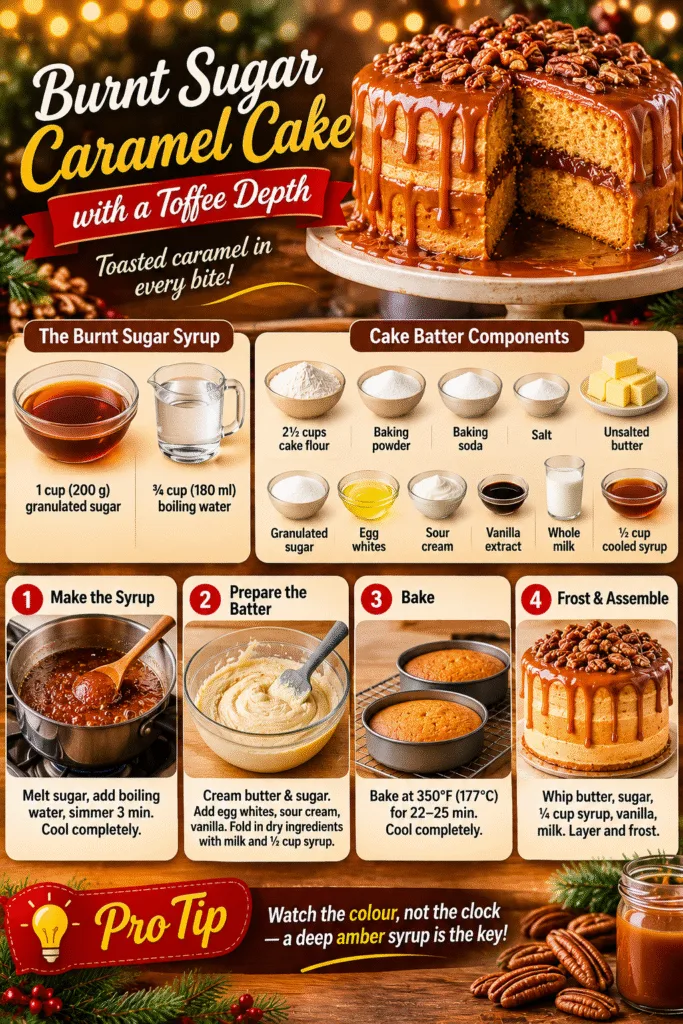
The Burnt Sugar Syrup
- 1 cup (200 g) granulated sugar
- ¾ cup (180 ml) boiling water
Cake and Frosting Components
The batter uses 2½ cups cake flour, baking powder, baking soda, salt, unsalted butter, granulated sugar, egg whites, sour cream, vanilla extract, whole milk and ½ cup of the cooled burnt sugar syrup.
The frosting combines unsalted butter, confectioners’ sugar, ¼ cup of the cooled syrup, vanilla, milk or heavy cream and salt. Salted caramel or toasted pecans can be added between the layers.
Making the Cake Step by Step
- Make the syrup. Melt the sugar in a heavy saucepan over medium heat for 8 to 10 minutes, until it turns deep amber. Carefully drizzle in the boiling water, simmer for 3 minutes, and let it cool. Take care here, because hot sugar and boiling water can spit.
- Prepare the batter. Heat the oven to 350°F (177°C) and prepare two 9 inch pans. Cream the butter and sugar, then mix in the egg whites, sour cream and vanilla. Fold in the dry ingredients, the milk and ½ cup of the syrup in alternating additions.
- Bake. Pour the batter into the pans and bake for 22 to 25 minutes, until a toothpick in the centre comes out clean. Cool completely.
- Frost and assemble. Whip the softened butter, confectioners’ sugar, ¼ cup of the syrup, vanilla, milk or cream and salt until smooth. Layer the cakes with frosting and salted caramel, frost the outside, and finish with extra caramel or pecans.
If you have ever pulled caramel off the heat too early or too late, this is the cake that rewards paying attention. Watch the colour, not the clock.
Choosing Your Christmas Cake by Time and Effort
The fastest way to decide is to look at what each cake demands before it reaches the oven, and how long it stays there.
| Cake | Prep before baking | Oven temperature | Baking time |
|---|---|---|---|
| Jamaican Christmas cake | Fruit soaked for 2 to 7 days or longer | 250°F to 300°F (120°C to 150°C) | 1½ to 2½ hours |
| Cranberry Christmas cake | Whip eggs and sugar for 5 to 7 minutes | 350°F (175°C) | 42 to 50 minutes |
| Mulled wine cake | Syrup and wine, about 15 minutes | 350°F (175°C) | 22 to 26 minutes per layer |
| Chocolate chip cake with ganache drip | Chill the frosted cake for 20 minutes | 350°F (177°C) | About 25 minutes per layer |
| Burnt sugar caramel cake | Syrup, 8 to 10 minutes plus 3 minutes simmering | 350°F (177°C) | 22 to 25 minutes per layer |
If you want a cake that gets better after a day or two of resting, the Jamaican cake is the obvious choice. For a bake that fits into an ordinary afternoon, the cranberry cake needs the least preparation.
The mulled wine cake can be split across two days, since the sponge and the wine reduction keep for up to 2 days in the fridge. The chocolate chip cake and the burnt sugar cake are the two layer cakes for people who like a frosted, celebratory finish, and the difference comes down to chocolate or caramel.
Questions Bakers Ask Before Christmas
How far ahead should I start the Jamaican Christmas cake?
The fruit needs at least 2 to 7 days in the rum and port, and it can stay there for several months if you keep it topped up so the fruit is always covered. After baking, wrap the cake and leave it for 1 to 2 days before slicing. Count backwards from your serving day and start the soaking first.
What should I do if the Jamaican cake batter starts to curdle?
Add 1 tbsp of flour while you are beating in the eggs. Adding the eggs one at a time and beating well after each also helps.
Can I use frozen cranberries in the cranberry cake?
Yes. Fresh or frozen both work, and frozen berries should go into the batter without being thawed. Fold them in by hand so they stay whole.
Can I use something other than mascarpone in the mulled wine frosting?
Full fat cream cheese, softened slightly, can replace the mascarpone. Keep the cream cold either way, since the frosting relies on whipping it to stiff peaks.
Will burnt sugar caramel cake taste bitter?
Not if you stop cooking the sugar at a deep amber colour. At that point the syrup tastes like toasted caramel. The sugar takes about 8 to 10 minutes over medium heat, but the colour is a better guide than the clock.
Which of these cakes contain alcohol?
Two of them do. The Jamaican cake uses rum and port wine for soaking the fruit and for feeding the finished cake, and the mulled wine cake uses red wine in the syrup, the brushing liquid and the frosting. The cranberry, chocolate chip and burnt sugar cakes use none, which is worth knowing if you are baking for a mixed group.
Pick One and Get Started
A cake that suits your schedule will taste better than an ambitious one you rush. If you can plan ahead, begin soaking fruit this week for the Jamaican cake. If you cannot, the cranberry cake and the mulled wine sheet cake both fit into a single afternoon.
You may also like
About The Author
